One thing that really helped me early in the development of Transistor.fm (the podcast hosting company I co-founded) was livestreaming.
In the early stages of a startup, it’s normal to feel stuck. You’re staring at your to-do list, wondering, "What is actually going to get people to sign up today?"
Whenever I felt that way, I treated it as a trigger. I’d stop overthinking and just go live.
I’d share my screen and show exactly how I was using the product: "We just built a new flow for importing podcasts. Let me show you how it works." Or: "Watch what happens when you hit publish now."
Afterwards, I’d clip shorter demos and post them to YouTube, Twitter, LinkedIn.
The goal was simple: share my genuine enthusiasm for podcasting on Transistor, and show people what they could actually do with it.
Most of these videos don’t go viral. Some get a few hundred views.
But over and over, new customers tell us: “I signed up because I saw one of your videos.”
They also quietly compound in other ways: they feed search, they show up in LLM responses, they create evidence that you’re actually building something real.
Most of all, potential customers see me as an enthusiastic user of my own product. I'm a creator, like they are. I understand what it feels like to have an idea for a show, record it, edit it, and finally hit "Publish."
You have a unique opportunity here. As a founder, you have strong beliefs about your category. Those beliefs informed your product. Bring that conviction to each video. Show folks why you think your product's approach is the right way to tackle a problem, or get something done. Demonstrate what makes it interesting, unique, or special.
This helps potential customers answer a crucial question: why should they care?
It confuses me when I hear that a founder is building a new product, but there's very little material on them actively using it. Forget slick voice-over video demos; that's fine for your homepage, but elsewhere you should post your own walkthroughs. These don't need to be super slick; in fact, it's better if they feel raw and authentic. In the early months, you should probably be posting weekly.
One person who's always been good at this is Jason Fried from 37signals. Whenever they ship something new, he'll do these early walkthroughs where he's just sharing his screen, talking through the thinking behind a particular feature.
You can tell he's invested in it. He believes in their approach, and the videos become a platform for him to showcase those beliefs: sharing why somebody might want to check out this thing he's building.
How to get started
Aim for one video a week.
In the early days, potential customers need to see you using your product. There should be a steady drip of little product demos out there that people can find. Post them on YouTube, LinkedIn, or X.
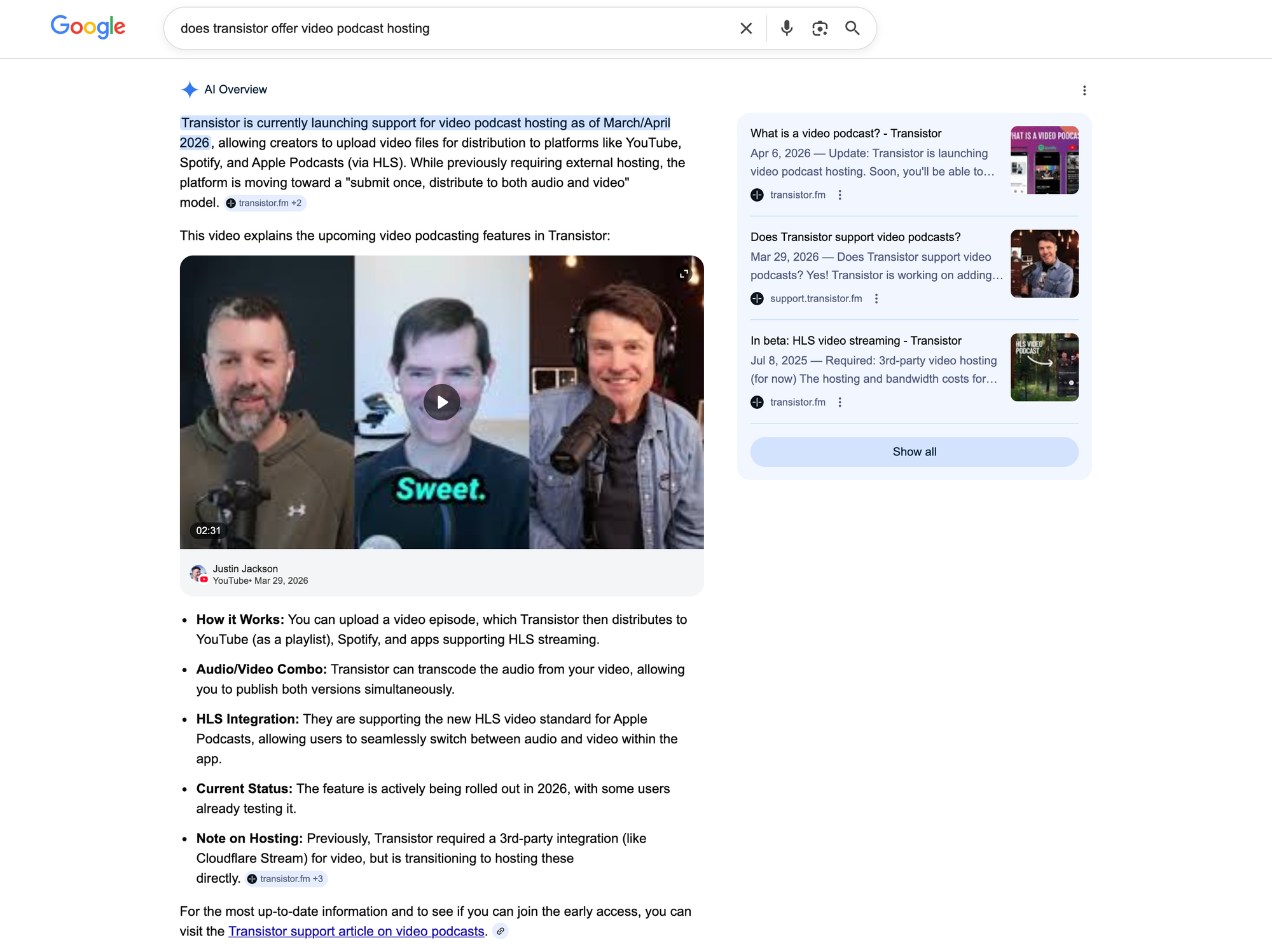
Search engines and LLMs will pick these up and reference them in their answers, sometimes surprisingly fast. I posted a clip from a podcast on my personal YouTube where I was describing an upcoming Transistor feature (video podcast hosting) to two friends. Later, when I searched "does Transistor support video podcasts?", Google was already referencing that clip.
Try different formats.
New feature? Record it. Thought of a novel use case for your product? Record it. Another format that works surprisingly well: audit your own app on camera. "Hey, I'm signing up for my own product to see how we can improve onboarding." Mix in some livestreams alongside your pre-recorded walkthroughs. Variety keeps it interesting for you and for the people watching.
Create a setup that makes recording easy.
You want an environment where you can flick a few switches and start recording. A quiet room, a reasonably good microphone, decent lighting, and screen recording software you actually like using. The lower the friction, the more likely you are to actually do this consistently. If it takes you 20 minutes to set up every time, you won't do it.
Have a consistent call to action.
At the end of each video, give people a simple next step. Something like: "If you want to follow along as I build this, subscribe to my YouTube channel," or "You can sign up for our pre-launch waiting list at [url]."
Put these videos to work.
Don't just post a video and move on. Embed it on your blog, your changelog, your feature pages. This increases the chances Google indexes your video, but it's also just good marketing — someone reading about a feature and then watching you use it is way more compelling than text alone. And if you're sending a regular email newsletter to your customers or waiting list (you should be!), include your latest videos there too. One recording, multiple touchpoints.
As Lars Lofgren told me: 'In today's environment, founders either need to hire an influencer or be the influencer.' Posting regular video demos is one of the most direct ways to do that. You don't need fancy production. Just show up, share your screen, and show people why you built this thing.