V. After You Launch
Get more leads
After you launch, your biggest need will be filling the top of your marketing funnel with leads. Here are some tactics to get your started.
Email the people you know
For his new product, Drip, Rob Walling emailed 17 founders. These were people he knew, like Crazy Egg’s Hiten Shah. In his email, Rob asked a specific question:
I don’t want you to tell me that you think this is an interesting idea; I want to know if you would actually use and pay for it.
Building relationships with people in your target audience, and then emailing them, is an excellent way to get your first customers.
This approach applies to products that have already launched as well. Write a personal email that looks something like this:
Hi [name],
We’ve known each other since we met at [location] in [year]. It’s been fascinating to see your business, [business name], grow over the years.
As you know, I’ve been working on [my product]. The aim is to help business owners [value proposition].
Do you already have a solution for this? If not, I’d love to give you a free trial for [my product].
If you’re already using something, let me know. It’d be great for you to take a look at [my product] and tell me what might help you switch.
Cheers, [your name]
Always be building relationships! You can’t build a network overnight, but here are some unique ways to meet new people and get out of your comfort zone:
1. Buy someone lunch
There was a CEO that I wanted to meet, but I was never able to connect with him at social events. So I wrote him an email with the subject line: “Can I buy you lunch?” In the email, I said, “You’re a business leader that I respect. I want to get better at x. Can I take you for lunch?” He replied and said, “I’d love to go for lunch, but you don’t have to buy.”
Everyone likes going to lunch. Be generous, and you could receive enjoyable company, and great advice, in return.
2. Start a podcast
This one isn’t for everyone, but I’ve been able to have amazing conversations with interesting people through my podcasts (Build & Launch, Product People). Podcasts are great because they give you a good reason to have a conversation with interesting people. Most folks are flattered when you invite them to be a guest on your show.
You don’t need to be naturally outgoing or extroverted to record a podcast. Some of the best hosts I know are the opposite!
3. Start a meetup
My friends Kevin and Jared didn’t like the other networking events in town, so they decided to start their own: Nerds Night Out. Instead of doing the “normal” thing and have a presenter, they just get together for drinks at a pub. They started small by inviting a few other people in the web development community. It gradually grew, and now 10–25 people come each month.
4. Take a class; in a different city
One way to meet a whole new group of people is to take a class in a different city. I went to a Ruby Weekend in Las Vegas. It was actually easier meeting people as the out-of-towner because I was unique (I was the only non-local). I still keep in touch with people from this class.
5. Volunteer at an event
Every event organizer needs help: a photographer, a sound person, a host (to welcome people). When you volunteer, you get to meet the organizing team, and anyone attending the event. (Plus, you usually get to attend and participate for free.)
5. Go to a conference, and look for ways to help
My friend, Mike Bridge, goes to events and takes photos. When he takes pictures of attendees and speakers, he offers to email people their photographs.
When Kai Davis attended MicroConf, he took detailed notes from each speaker’s presentation and offered to send them to attendees.1
These are great techniques: they help you make meaningful connections and provide you with an excuse to follow up with people.
Email people you don’t know
Before he’d even built WPEngine, Jason Cohen talked to 50 people and asked them if they would pay $50 each month for stable WordPress hosting. Then he asked them for a cheque towards their first month. In his 2012 interview on Mixergy2, he explained his process:
Anyone can do this. You go to LinkedIn, and you search for the type of person that you want to interview. I found people who were professionals, that is, they charge money for their time. Then, I contacted every one of them, which is easy, since, as they are consultants you can find them, and their email addresses and they answer it because that’s their sales line. So, it’s very easy to contact people who are professionals in the field. So, I would send an email to each one, and this is what I’d say exactly. I’d say, “Hey, we’re thinking of building these new tools for WordPress. You are exactly the kind of person who we’d want to use these tools. I would love to get your opinion.” Here’s the result, 100% of them agreed to the interview.
Jason used this tactic to validate his idea before launching, but you can use it to find customers after launching as well. One key is Jason offered to compensate them for their time. He knew that some of these professionals charge $200 per hour, but he was willing to pay because it showed respect to the consultant. Interestingly, not one person took him up on his offer.
Ask for referrals
Using the previous two techniques, you should be able to get your first five customers. What do you do now?
Ask those customers for referrals! Make it an automatic process for every new client. Once they’re using your product, send them an email like this:
Hi [name],
It looks like you’ve been using [my product] for a couple of weeks now! Thank you, I’m glad to have you as a customer.
You seem like you’re well connected in the [industry name] circles. Do you know anyone that could benefit from [my product]?
If so, could introduce them to me? I’ve attached a template you can use to email them.
Cheers,
[your name]
Having the above conversation over the phone might be even more powerful. The key is to ask.
Many people get uncomfortable asking for referrals. Steli Efti, the founder of Close.io, thinks they’re missing out on a tremendous opportunity:3
Referral sales can be your #1 source of new leads and turn into a massive growth engine for your B2B startup if you do it right. Why are so many sales people doing referral sales wrong? Because they’re afraid. It’s scary to ask for more once you close a deal. Sales people worry that they might jeopardize a deal, or that it’ll turn a positive conversation awkward. Go where others are afraid to go, and you’ll find massive opportunity. Don’t let fear get in the way.
Don’t complicate this by implementing an affiliate scheme, or trying to reward customers for their referrals. Most satisfied customers are happy to do this for you. They don’t want payment.
Have a point of view that gets people talking
From the beginning, it was clear that Basecamp’s Jason Fried and David Heinemeier Hansson had strong opinions. In their book, Rework, they spell it out:
Great businesses have a point of view, not just a product or service. You have to believe in something. A strong stand is how you attract superfans. They spread the word further, wider, and more passionately than any advertising could.
Not everyone likes Basecamp. But the founders have drawn a line in the sand: they’re clear about what they believe in.
A point of view invites discussion: “Can you believe they said this?” “What do you think about this?” “I agree with them.”
Share your process
When Alex Turnball started Groove, he knew he wanted to do things differently than he had with his first company, Bantam Live. Groove is help desk software for small businesses.
Instead of buying ads or starting an affiliate program, Alex decided they would publicly share Groove’s journey from $28,525 to $100,000 in monthly revenue.4
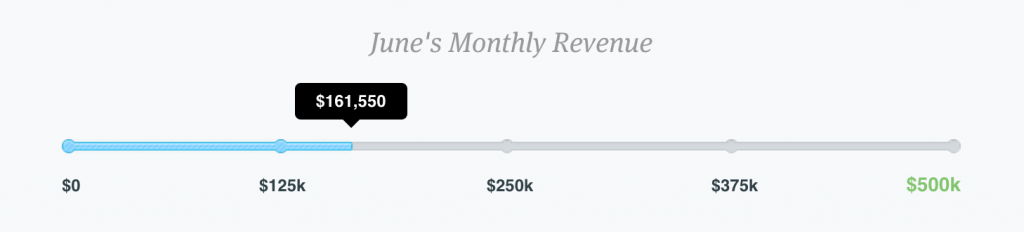
Groove made their revenue numbers transparent
In 14 months, the Groove team wrote over 50 blog posts detailing the tactics they used (and the lessons they learned) to get to $100k in recurring revenue. People responded to it in a big way. Over 30,000 people signed up to get regular updates on the company’s progress.
The next step
A lead is a potential customer: someone who has the intent to buy and the budget to do so. Someone knowing about your product isn’t enough. Nurture your leads from initial contact through a series of steps up until the purchase. In the next chapter, we’ll look at the sales funnel and how you can keep your leads engaged.
Footnotes
-
WP Engine: How A Startup Reached $1M in Sales in Less Than a Year - with Jason Cohen, Mixergy, 2012 ↩
Buy the EPUB & PDF to read offline and support the work.
Buy the book — $10