IV. Launching
Your launch plan
You’ve done all the hard work. You’ve picked a target market, you’ve discovered what people want, and you’ve built it. Now it’s time to launch!
Launches can be scary. There’s so much to do, and it’s easy to get frazzled. This chapter will guide you through the process, so you can maintain your Zen without going off the rails.
Because every product is different, it’s difficult to provide an exact launch timeline. What I’ve provided below is a general template. Please modify it to fit your product and your market!
Backward planning
Most people plan their launches sequentially. We’re going to work backward from your launch day. Educators and industrialists have used reverse planning for years:1you start with the end objective and work backward, step by step until you get to the present day.
Launch day
Announce your launch by sending an email to your email list with a unique discount code that expires in 48 hours.
You should also mobilize your friends, early reviewers, and team to share the news on social media, and websites that your audience frequents.
Day before launch
Send an email to your list, reminding them that launch day is tomorrow. It should contain details like time, price, packages, the discount you’ll offer, and answers to frequently asked questions.
Also, send an email to your friends, early reviewers, and team, prompting them to help you with tomorrow’s launch. Coordinate who will help you post it to relevant sites: Product Hunt, Reddit, etc.2
Do a final test of everything:
- Is your payment processor working?
- Do you have analytics installed on your site?
- Is the pricing or sales page ready to go? Do all the links work? Is all the copy proofread?
7 days before launch
Write a blog post. The objective is to create anticipation for what you’ll be launching in one week. Include a link to your landing page so that people can sign up for the waiting list.
Send an email to your list, getting them ready for the launch. Give them a tease: this could be a sample of the product, a screenshot, or a video demo.
Remind your “street team” about the launch date as well.
Your product itself should be 99% finished. At this point, you’re just polishing it and doing final tests.
1 month before launch
This is your final hustle. You’re focused on your product; getting everything finished.
Remember to keep your email list and blog tuned into your progress. They want to hear the behind the scenes!
Tease out screenshots and early reviews through email and social media.
2 months before launch
Steady progress on your product. At this point, you should have something to show your beta list.
Send an email to your beta list and get people using your app. Watch them using the product in-person. Listen carefully to their first impressions. Take notes! Use this research to make your final product updates.
3 months before launch
Your first launch step should be to set up a landing page. This page should:
- State who your product is for.
- Show the primary benefit your product provides.
- Have a clear call to action: “Sign up for the waiting list,” “Download a sample,” “Join the beta!”
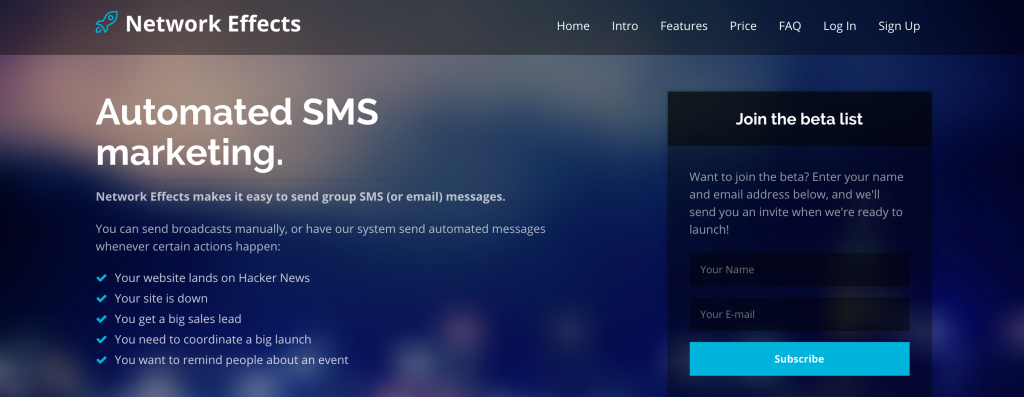
For software products, the call to action is often “Sign up for our beta!”
Your objective at this point is to get as many email sign-ups as you can. You can drive traffic to your landing page by:
- submitting to sites like betalist.com (you can find a full list at submit.co)
- sharing your landing page on social media and in your content
- guest posting on other blogs with a link to your landing page in your byline
- appearing on podcasts as a guest, and getting them to link to your landing page in the show notes
Get out your calendar
Now that you have an outline, it’s time to get out your calendar. Working backward from your launch date, put each of these milestones in your calendars. If you’re using Google Calendar (or something similar), get it to email you a reminder of each event. This will help keep you on track, especially if your head is in code!
The next chapter has a checklist you can use to keep track of your progress.
Footnotes
Buy the EPUB & PDF to read offline and support the work.
Buy the book — $10